
Mississippi “Power Play” summit
Politicians will often tell you that they want you to help guide them in making good decisions. I’ve heard this enough times, and participated in enough of these efforts, that I have grown fairly skeptical of their sincerity. But I have to admit after participating in a meeting in Jackson, Mississippi, last week with their governor Tate Reeves, that I think he really does want to know the best way forward for energy in his state.

Flibe Energy is based in Huntsville, Alabama, but almost directly to the west of us is a unique site in the state of Mississippi. The Yellow Creek nuclear power plant was being built by the Tennessee Valley Authority from the mid-1970s into the early 1980s. It was cancelled, along with about four other nuclear power projects, by the anti-nuclear head of TVA at the time, S. David Freeman. Freeman believed that nuclear power was on its way out, and that solar power would provide all the energy of the future. So Yellow Creek, along with other TVA plants like Hartsville, Phipps Bend, Bellefonte, and the Clinch River Breeder Reactor, were all cancelled after significant construction began.
I learned about the site in 2008 while I was still working for NASA and was enamored with its potential. Since 2019, Flibe Energy has been leasing the nuclear portions of the site from Tishomingo County in Mississippi and improving the land to work towards this possibility. We have increasingly taken the opportunity to apprise stakeholders at the state level about its value. I was able to make a presentation to the Public Service Commission in Jackson last October, and in March, the head of that commission came to Yellow Creek and toured the site with us. He has become very interested in its possibilities for future power generation as well.
Mississippi already has a nuclear power plant, located on the western side of the state near the Mississippi River. The Grand Gulf nuclear plant is a single-unit plant (although it was originally designed for two units) and is operated by Entergy, a large power company that also has operating nuclear reactors in Louisiana. So nuclear energy is not unknown in the state, but it is not as large a contributor to the state’s energy supply as it is in the neighboring states of Alabama and Louisiana. In Alabama we have five nuclear reactors, three at Browns Ferry in the north, along the Tennessee River, and two at the Farley site in the southeast.
The state also has a large number of natural-gas-fired power plants based on combustion gas turbines. This source of power has been steadily growing for many years now, and the state also has an extensive network of natural gas pipelines. TVA, Southern Company, and Entergy all provide power to sections of Mississippi and natural gas has become a bigger and bigger part of that energy portfolio.
It was against this backdrop that the governor, Tate Reeves, called together a summit meeting that included leadership from industry and government. We met on the morning of May 1st in a venue called “Rickhouse by the Manship“. I literally have no idea what that means, but it was a nice area to meet.

Representatives were there from the major utilities that serve the state, along with large pipeline and refinery interests. There were two of us there from the advanced reactor community, Ben Reinke of X-energy and me. The governor made his opening statements and then, to my surprise, he asked Ben and me to be the first people to speak. Ben talked about the work X-energy is doing on their ARDP award and their anticipated facility in Seadrift, TX, along with Dow Chemical. When I had my chance, I told the governor that dramatic rises in the cost of uranium fuel threatened the viability not only of future nuclear energy, but even those in operation today. I told him that thorium, utilized in molten-salt reactors such as our LFTR design, offered a pathway around those increased fuel and construction costs. I told him that Flibe Energy had been leasing the nuclear-related portions of the old Yellow Creek site in northeast Mississippi now for five years and that we had put considerable funds into improving it.
From our statements the governor launched into an extensive conversation about nuclear energy with many of the participants. At one point he asked a pointed question about why any utility would be considering shutting down an existing nuclear power plant. I took the initiative to answer that, saying that each site had a decommissioning fund associated with it, and increased in fuel prices and operating costs made the shut-down of a nuclear site a tempting financial target. A plant could be announced for decommissioning, thereby freeing up the utility to activate the decommissioning fund. In most cases, the utility then turns around and sells the site and the decommissioning fund for about fifty cents on the dollar to a company like Energy Solutions or Holtec, enabling them to book a large amount of revenue that quarter and to remove the entire nuclear liability from their books. In many states, it also then opens a wedge with the Public Service Commission to then replace the generation that was lost with new construction, upon which they are guaranteed to earn a fixed profit. So they can create a problem, get paid for that, and then get paid again to fix it. That doesn’t necessarily apply to many nuclear power plants in the southern US, but it has happened in many other parts of the United States.
At another point the governor said, “I think we all agree that the future is going to be nuclear” and I took that as a very good sign. The only question is what kind of nuclear? From nuclear the discusssion segued into oil and gas and pipelines and refineries, all important topics to be sure, but not those in which I had a great deal of understanding or expertise to contribute to the discussion. I was very grateful that as the day progressed I had an opportunity to meet with many of the other participants, and to exchange business cards and LinkedIn contacts.
After the summit concluded, we all walked down the street for a lunch event where the discussion and networking continued. I was grateful for an opportunity to take a picture with the governor, who thanked me for my attendance. After lunch he gave a press conference describing the events of the morning, and I headed back to northern Alabama.
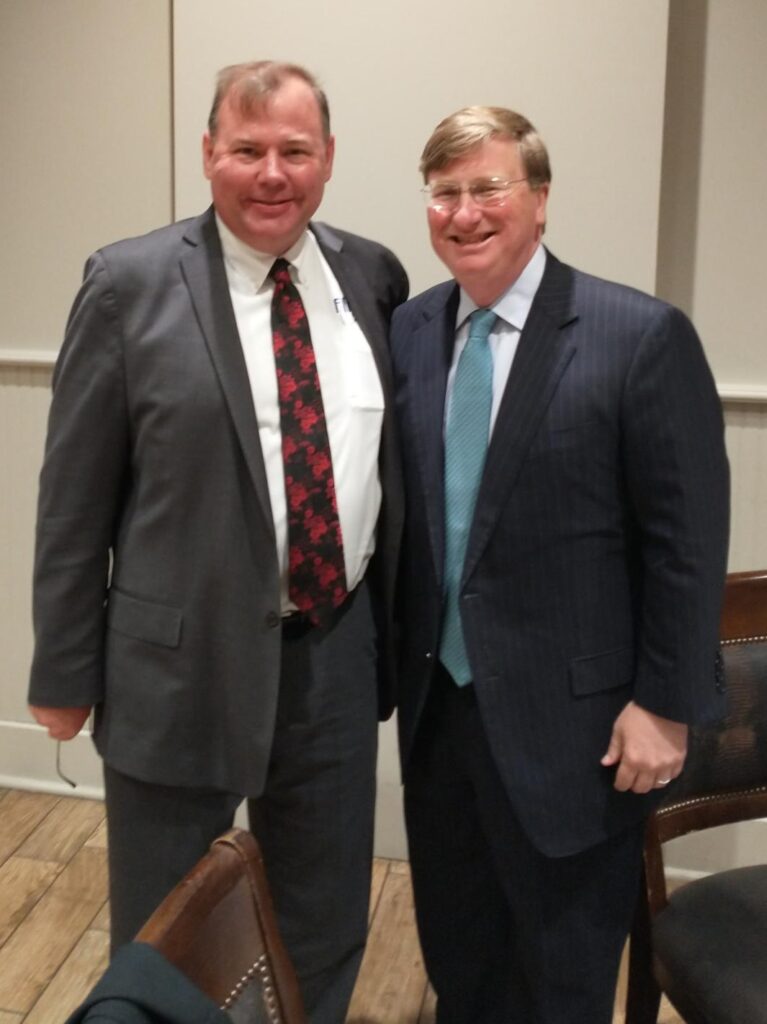
This was my first engagement with the governor of Mississippi, but I was very favorably impressed. I know that Mississippi has a tremendous role to play in meeting our nation’s future energy needs, and I am very glad that governor Reeves is taking the proactive position on this topic that he is. I hope each of us that attended can help him in this important work.